

How connected forests and local communities are creating room for big cats—and countless other species—to survive in Nepal
Imagine a tiger reaching the edge of a protected forest.
Behind it lies habitat with the cover, water, and prey it needs. Ahead are roads, farms, towns, and scattered patches of forest. Somewhere beyond them may be another protected area—and other tigers—but only if the animal can find a safe way through.
September is Save a Tiger Month, an opportunity to celebrate one of the world’s most extraordinary animals. But if we want to save tigers, admiration is not enough. We must understand what their survival requires.
A tiger needs more than a park. It needs a landscape.

Tiger in Chitwan National Park (photo courtesy of Nepal Tiger Trust)
Why big cats matter
Tigers and other big cats sit near the top of the food chain. As predators, they are part of the ecological relationships that influence where prey animals move, how they behave, and how populations interact across a landscape.
Their presence can also tell us something important about the land itself. A forest capable of supporting a tiger must provide sufficient space, cover, water, and prey. Those same conditions support many other forms of life.
That makes the tiger an “umbrella species.” Protecting enough habitat for this wide-ranging predator can also safeguard forests used by elephants, sloth bears, pangolins, deer, birds, and many smaller species that receive far less public attention.
Healthy forests also matter to people. They protect watersheds, store carbon, hold soil in place, and provide food, materials, and livelihoods. The space a tiger needs is not valuable only because a tiger may cross it. It is part of a functioning landscape on which wildlife and human communities both depend.

Left: Tiger tracks. Right: A tiger by the river
Why big cats need room to move
Even a well-protected national park cannot meet every need if it is cut off from the surrounding landscape.
Big cats travel to find prey, establish territories, locate mates, and disperse into new areas. Young animals, in particular, may need to move away from the places where they were born. When forests are fragmented by development or separated by landscapes animals cannot safely cross, populations can become isolated.
Over time, isolation can limit breeding opportunities and genetic exchange. It can also push animals into closer contact with people as they attempt to navigate farms, settlements, and roads.
Wildlife corridors help connect larger areas of habitat. But a corridor is not necessarily an untouched strip of wilderness. In Nepal’s human-inhabited corridor landscapes, it may be a network of community forests and other locally managed lands that allows wildlife to move between protected areas.
From the tiger’s perspective, each forest is a possible stepping-stone. From a conservation perspective, each community is an essential partner.
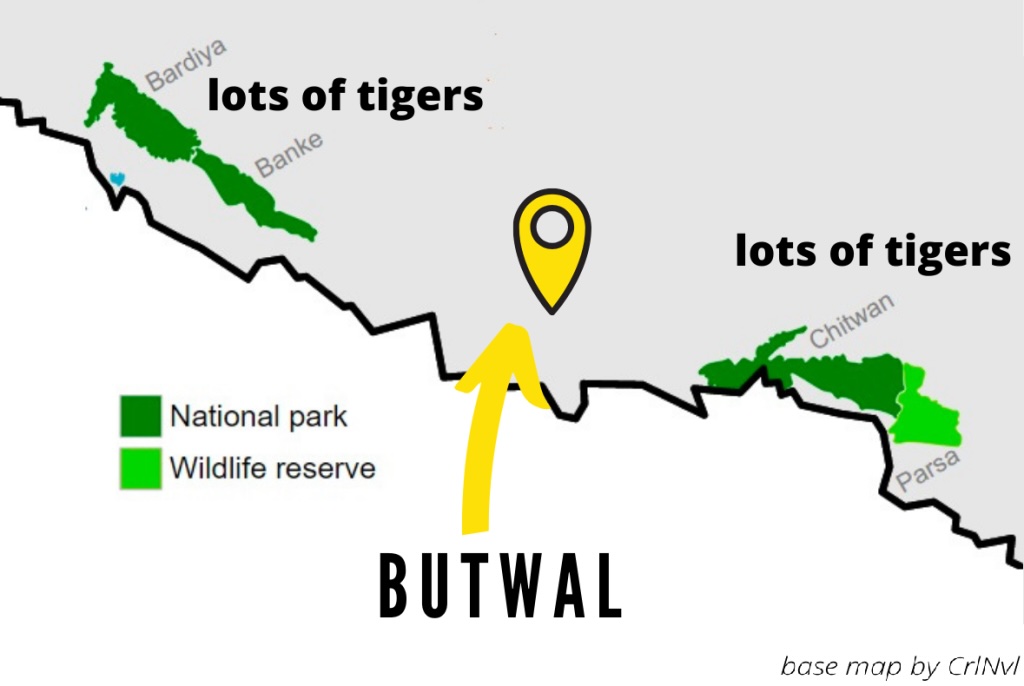
Is Butwal a passage or a barrier?
Near Butwal in central Nepal, Community Conservation has supported local community forest groups to investigate a crucial question.
Butwal is a large metropolitan area situated between Chitwan and Bardia National Parks, two important tiger strongholds. Tigers have been observed in the surrounding area, suggesting that some may be attempting to move through this human-dominated landscape. But are they successfully passing between the protected areas, or has Butwal become a bottleneck?
To find out, the team has worked with local residents to identify places where tigers may travel. Researchers look for tracks and scat, install camera traps, and use genetic analysis to examine whether tigers found on opposite sides of Butwal are still breeding with one another.
The answer matters because a tiger sighting alone does not prove that a connected population exists. We need to understand whether individual animals can move safely enough to maintain genetic connections between populations over time.
This work combines scientific tools with community knowledge. Residents know their forests, recognize changes, and often notice signs of wildlife that an outside researcher might never find without their help. Read more about tiger tracking here.

Other species caught on camera trap in the corridor.
Building a corridor through community forests
Farther east, Community Conservation and our local partner, the Nature Conservation and Study Centre, are pursuing an even larger vision: a corridor of community forests across southeastern Nepal that can provide habitat and movement routes for tigers, Asian elephants, pangolins, sloth bears, and other wildlife.
The steps sound straightforward: raise awareness, help community forest groups monitor and manage wildlife, and build a network through which those groups can coordinate across the landscape. Carrying them out across multiple districts and communities, however, requires patience and long-term trust. Community Conservation has worked in Nepal since 2012, while Executive Director Dr. Teri Allendorf’s relationship with the country dates to her Peace Corps service in 1991.
In 2024, our team traveled through five districts—Udayapur, Saptari, Sunsari, Jhapa, and Morang—to meet with community forestry groups, government officials, volunteers, and other local partners. In Udayapur, camera traps documented 21 wildlife species. Sharing the resulting photographs and videos helped residents see the diversity living in nearby forests and sparked interest in further monitoring.
Camera trapping gives communities evidence they can use. It helps distinguish changes in wildlife populations from impressions or isolated encounters. It can identify conservation priorities, reveal possible movement routes, and give residents a clearer basis for deciding how their forests should be managed. Read more here about expanding the wildlife corridor in Nepal.

Community meetings
A corridor is also a network of people
Connecting forests on a map is not enough. Wildlife corridors succeed only when the people who live along them see a reason to protect them.
When community forest groups in Jhapa and Morang identified poaching—particularly the hunting of deer—as a major threat, they learned from community-based anti-poaching units working near Chitwan National Park. Local representatives then decided to form their own groups, electing committees and beginning the process of registering them with the government.
These community-based anti-poaching groups (CBAPUs) are locally organized responses to locally recognized problems. They can raise awareness, involve women who regularly use the forests, work with officials, and build community responsibility for wildlife protection. Read more about CBAPUs here.
This is what makes a wildlife corridor possible. It is not one organization drawing a line between two parks. It is many communities learning what lives in their forests, identifying threats, choosing actions, and coordinating across a landscape larger than any single village can protect alone.

Saving the landscape a tiger needs
Tigers capture our attention because they are powerful, beautiful, and rare. Their conservation asks us to look beyond the animal itself.
To save a tiger, we must protect prey populations. We must reduce poaching. We must understand where wildlife is moving and where that movement is blocked. We must conserve the forests between protected areas, not only the parks themselves. And we must support the local people making daily decisions about those forests.
That is the promise of community-led conservation: not simply preserving isolated pockets of habitat, but helping people build a living, connected landscape in which wildlife can move and communities can thrive.
This Save a Tiger Month, we invite you to help create the room tigers need. Your support helps communities monitor wildlife, strengthen local conservation groups, address threats, and connect forests across Nepal. A gift of $240—just $20 a month for one year—can train five community members in biodiversity monitoring.
Give a gift today to support community-led wildlife conservation. And consider joining us in Nepal this December for a chance to see these beautiful cats in their natural habitat.